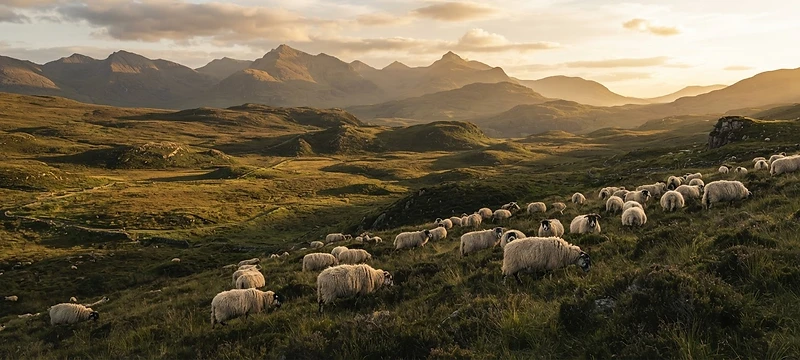
~11,000 years agoDomestication in the Fertile Crescent
Archaeological and DNA evidence shows wild mouflon (Ovis orientalis) were domesticated in the Fertile Crescent — modern-day Iraq, Syria and Turkey — making sheep among the very first livestock. Early sheep were hairy, like goats, kept for meat, milk and skins.
Sources- — Nature (2022) — Ovis aries domestication genomics
- — Smithsonian — Origins of agriculture
~6,000 BCEThe emergence of woolly fleeces
Selective breeding gradually produced sheep with continuously growing woolly fleeces (replacing the hairy outer coat). Evidence of spun wool appears at sites in the Near East and Central Asia, marking the birth of the wool textile economy.
Sources- — Journal of Archaeological Science — early wool
~5,500–4,500 BCESheep reach Neolithic Europe
As farming spread westward with the Linear Pottery (LBK) culture, sheep accompanied the first farmers into central and western Europe. By the late Neolithic, sheep were established from the Mediterranean to the British Isles and Scandinavia — the foundation stock of Europe's later wool economies.
Sources- — Antiquity journal — Neolithic livestock dispersal in Europe
- — Journal of World Prehistory — LBK animal husbandry
~3,000 BCEWool drives Bronze Age trade
By the Bronze Age, wool was a major traded commodity across the Near East and the Mediterranean. Sheep flocks feature in the cuneiform archives of Mesopotamia and the textile workshops of Minoan Crete.
Sources- — British Museum — Mesopotamian textile records
- — Cambridge Ancient History
~2,500 BCESacred flocks of ancient Egypt
Sheep were vital to the Nile economy — raised for meat, milk, wool and manure. The ram-headed god Amun (and the cult of Khnum) made rams sacred in certain regions, and 'wool-on-wool' textile fragments survive from Egyptian tombs. Tomb paintings depict large, well-organised flocks tended by herdsmen.
Sources- — British Museum — ancient Egyptian animal husbandry
- — Journal of Archaeological Science — Egyptian wool textiles
AntiquityGreece and Rome
Ancient Greeks and Romans prized wool. Roman estates ran vast flocks; woollen toga was the garment of citizenship. Roman selective breeding influenced later European breeds, and the annual sheep-flock census (the 'pastio') was a major enterprise of the empire.
Sources- — Pliny the Elder, Natural History — Book VIII
- — Oxford Classical Dictionary
12th–14th centuriesEngland's medieval wool trade
English wool became medieval Europe's most prized commodity, exported in vast quantities to the cloth towns of Flanders. The 'wool sack' sat in the centre of the House of Lords as a symbol of national wealth, and the wool tax funded kings, cathedrals and the Hundred Years' War. Monastic flocks of the Cistercians were among the largest and most profitable in Christendom.
Sources- — UK Parliament — the Woolsack tradition
- — Cambridge Economic History — medieval wool trade
13th–18th centuriesSpain's Merino monopoly
Spanish shepherds refined the Merino into the finest wool sheep in the world. Export of Merinos was a capital offence until the 18th century, making Spanish wool the foundation of national wealth. The transhumant 'Mesta' flocks moved millions of sheep between winter and summer pastures under royal protection.
Sources- — Royal Merino Flocks of Spain — historical records
- — Oklahoma State — Merino history
- — Klein — The Mesta (1965)
16th centurySheep sail to the Americas
Christopher Columbus brought sheep to the Caribbean on his second voyage (1493); Hernán Cortés and Spanish missionaries carried the hardy Churro into the Southwest, where the Navajo (Diné) adopted it and built a weaving tradition around its fleece. English colonists later brought British breeds to New England, making sheep one of the earliest domesticated animals of the New World.
Sources- — Oklahoma State — Navajo Churro history
- — Rouse — World Sheep (1970)
18th centuryMerinos leave Spain
Spain relaxed its export ban in the 1760s, sending Merino flocks to Saxony, France and beyond. Louis XVI established the royal flock at Rambouillet (1786), founding the influential Rambouillet breed. These exports seeded the great fine-wool industries of Germany, Australia and the American West.
Sources- — Oklahoma State — Rambouillet history
- — Australian Wool Innovation — Merino origins
18th–19th centuriesThe British Agricultural Revolution
British breeders — notably Robert Bakewell, John Ellman and the Colling brothers — systematised livestock selection. This era produced the Leicester, Southdown, Hampshire, Suffolk and Lincoln breeds that reshaped global sheep farming.
Sources- — Royal Agricultural Society — Bakewell and livestock improvement
- — Defra — UK breed histories
19th centuryThe colonial wool boom
Merinos and British longwools spread to Australia, New Zealand, South Africa and the Americas. 'Wool was the backbone of the Australian economy' — the 19th-century wool boom built railways, towns and fortunes across the Southern Hemisphere.
Sources- — National Museum of Australia — wool and national development
- — Te Papa (NZ) — farming history
20th centuryIndustrialisation & synthetics
Mechanical shearing, scouring and combing transformed wool processing. Synthetic fibres after WWII eroded wool's market share, but fine-wool innovation kept sheep farming central to rural economies from Patagonia to Mongolia.
Sources- — IWTO — 20th century wool trade statistics
- — FAO — livestock industrialisation
1996Dolly, the first cloned mammal
At the Roslin Institute in Edinburgh, scientists led by Ian Wilmut and Keith Campbell cloned Dolly from an adult sheep mammary cell — the first mammal cloned from a somatic cell. Born of a Finn Dorset and carried by a Scottish Blackface surrogate, Dolly reshaped biology, genetics and the ethics of animal breeding, opening the era of genomic selection in livestock.
Sources- — Nature (1997) — Viable offspring derived from fetal and adult mammalian cells
- — Roslin Institute — Dolly the sheep
21st centurySustainability & new wool science
Wool is rediscovered as a renewable, biodegradable, flame-resistant fibre. Merino performance wear, regenerative grazing and wool-based insulation position the sheep — humanity's oldest companion animal — at the heart of a circular textile future.
Sources- — IWTO — Wool and sustainability
- — Textile Exchange — Materials Benchmark